
Introduction — a dim room, a number, a question
Have you ever walked into a shop at dusk and wondered if the air remembers every solder joint made there? What if that memory—thick with fumes—never fades? Around assembly benches and heavy machinery, fume extraction for electronics and industrial applications can be the difference between clear breathing and chronic problems. I say this because I’ve watched small teams wear the same tired masks year after year while particle counts quietly climbed (it feels like a slow fog). Recent field checks and some workplace studies show elevated VOC and particulate levels in poorly ventilated bays—numbers you can’t ignore.
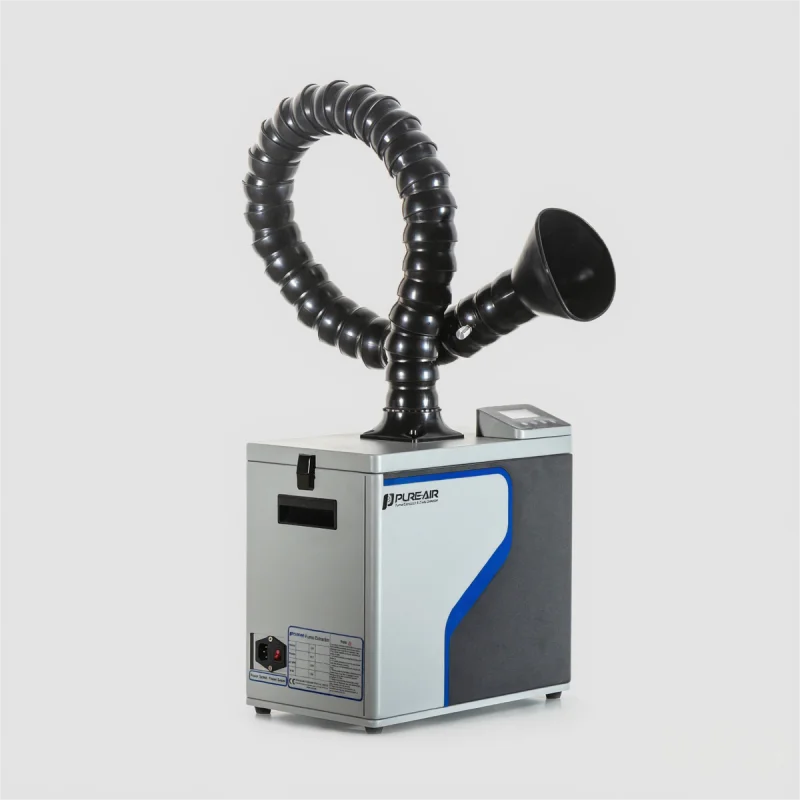
So I ask: are our fume systems keeping pace with modern manufacturing demands, or are we patching old designs and hoping for the best? The answer matters for worker health, product quality, and long-term costs. In the sections that follow, I’ll lay out the flaws I see in traditional setups and then sketch better paths forward—so we can stop tolerating the haze and start fixing it.
Why old fixes fail in electronic product manufacturing
When I talk about electronic product manufacturing, people picture neat lines of PCBs and tiny solder points. What they often don’t see are the limits of legacy extraction systems. Too many shops still rely on hood-only extraction, undersized fans, or filters rated for general dust but not for soldering fumes and VOCs. Those choices sound reasonable until you test them. Airflow rate drops with clogged ducts. Filter efficiency declines quietly. The result: contaminated recirculation, hotspots of poor air, and frustrated technicians.
Look, it’s simpler than you think—common fixes miss three key realities. First, contaminant chemistry matters: lead-free solder fumes and flux vapors behave differently than sawdust. Second, placement and capture velocity are everything; a wall-mounted hood thirty centimeters too far from a solder station will let smoke escape. Third, maintenance is often assumed rather than scheduled—filters ride until they fail. Those gaps add up. I’ve seen extraction arms that never reach the real source and HEPA filters used where activated carbon would be needed for VOCs. We need designs that match tasks, not one-size-fits-all gear.
So what can manufacturers realistically change?
Start by mapping the task. Measure where fumes originate, not just where machines sit. Consider targeted capture—local extraction arms, focused hoods—and pair them with appropriate filter media. Test capture velocity at the point of emission. Replace assumptions with simple, repeatable checks. In short: treat ventilation like a process step, not an afterthought.
Future outlook — case example and what to test next
I want to share a quick case: a mid-size board assembly line shifted from a central duct system to a hybrid layout—local arms at solder stations plus zoned room ventilation. We watched particle counts fall and quality rework drop. The team reported less eye strain. The moral? Granular control wins. In future-facing layouts for electronic product manufacturing, hybrid extraction (local capture + room dilution) offers both precision and redundancy. Pair that with sensible ductwork design and you cut energy use too.
What’s next—real-world impact and practical steps? First, pilot a hybrid setup on one line. Measure before and after: particulate counts, VOC readings, and worker feedback. Then scale what works. Don’t overcomplicate: small trials reveal big savings. — funny how that works, right? Also, keep an eye on controls; variable-speed fans and simple sensors can tune airflow to current needs without complex software. This reduces noise, power draw, and wear.
To help you evaluate systems, I recommend three clear metrics: capture efficiency at source (percent of emissions captured), filter media match (is the filter rated for the chemical species present?), and lifecycle cost (initial cost plus routine maintenance and energy). Use these to compare options side-by-side. I prefer solutions you can test quickly. They show results fast and build trust on the shop floor.

We owe it to our teams to move from guesswork to measured choices. When people breathe easier, work improves. For practical equipment and guidance, consider partners who understand both the shop floor and the science—like PURE-AIR. I’ve seen the difference a thoughtful system makes. And I want that for every technician I work with.