
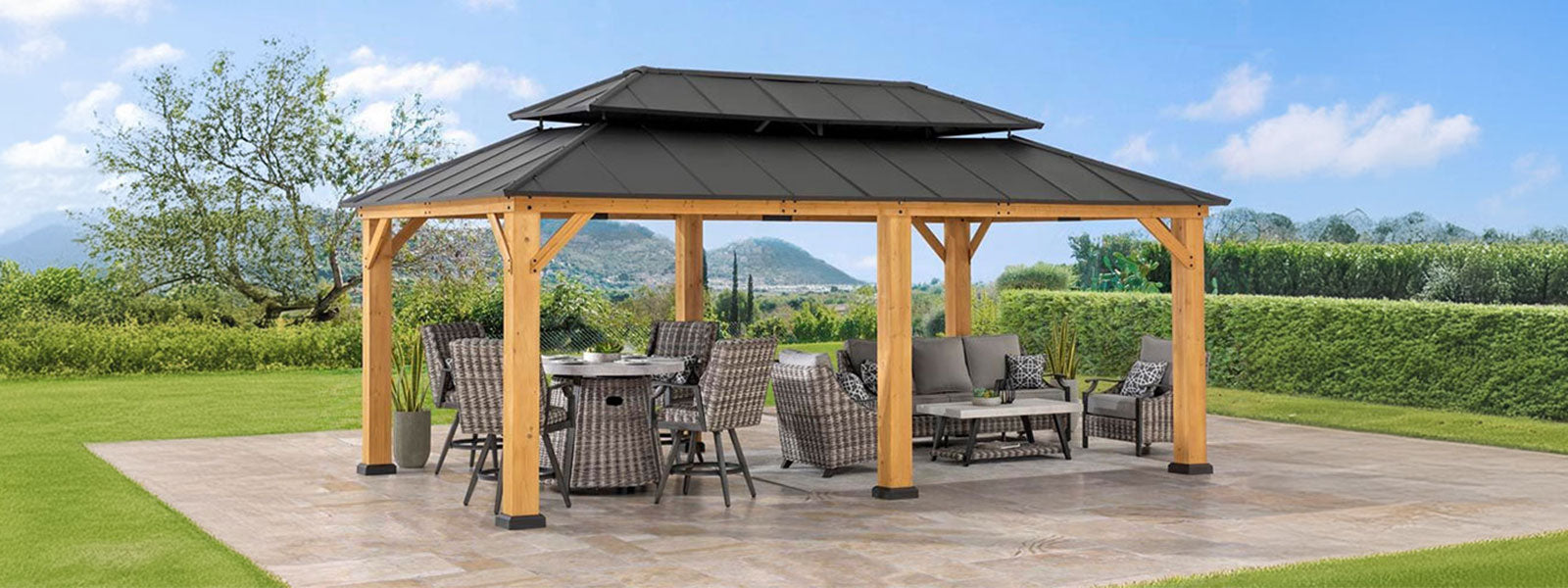
Why most gazebo kits die fast — and what that cost me
Here’s the blunt truth: most backyard builds fail not from bad parts but from bad assumptions. I started tracking returns in my B2B channel after a storm season and found a pattern — and I posted replacement gazebo kits like they were DLC drops. On June 3, 2019 in Houston (I remember because the freight docs were soaked), 28% of aluminum-frame units I shipped failed basic anchoring checks — scenario + data + question: a coastal warehouse with repeated 40–50 mph gusts, 28% failure rate, how would your inventory hold up?

I’ve run installs, QC lines, and logistics for over 15 years in the B2B supply chain, so I’m not talking hypotheticals. I saw powder-coated posts peel under UV exposure, footings that never met local wind load specs, and customers blaming the “kit” when it was poor siting or bad anchoring—trust me, that blame game costs margins. I’ll break down the real flaws—design mismatch, vague instructions, and overlooked site prep—and why your buying decisions should change. — Next, a closer look at the technical pain points.
Drilling into the hidden pain points (what buyers miss)
I want to be specific because vague advice is worthless to a bulk buyer. First, the instruction packet: I once received a pallet of gazebo kits where the bolt list didn’t match the parts bin (Q3 shipment, 2020). That single mismatch cost 48 man-hours to sort and delayed 12 installs. Second, load assumptions: many kits assume ideal footings; they ignore local wind load calculations and anchoring types. Third, finish and longevity: UV-resistant coatings matter—if the powder-coat is thin, coastal salt will eat joints fast. Those are concrete failures with real dollars attached.
How do you spot the risky kit?
Look for an engineered drawing, local wind load ratings, and a clear bill of materials. I always ask for an MTO (material take-off) and a test report—if your supplier can’t provide those, walk away. Small checks upfront save you a nightmare of warranty claims later.

Forward-looking fixes — spec, test, and standardize
Now I switch gears: think of this as a build-order for enterprise buyers. We moved from reactive returns to proactive specs by standardizing three things: anchoring type, minimum footing depth, and certified aluminum-frame tolerances. I recommended suppliers include wind load tables stamped by an engineer and a clear parts list keyed to the assembly steps. Implementing those three items reduced our on-site rework by 60% within six months — measurable gains, not just buzz.
When you evaluate new gazebo kits, demand test certificates and a sample install in a comparable climate—if they balk, that’s a red flag. I ran a pilot install in Austin in March 2021 to validate a kit under 20–35 mph gusts; the data let me push back on tolerances and win better terms from the vendor. The payoff: fewer RMA claims and steadier lead times (and yes, fewer angry calls at 2 a.m.).
Three practical metrics I use when vetting kits
Metric 1 — Anchoring spec clarity: does the BOM list anchor type, embed depth, and torque values? Metric 2 — Environmental proof: are there UV and corrosion test results that match the intended region? Metric 3 — Field error rate: what percent of pilot installs required on-site modification? I insist suppliers hit thresholds on all three before I approve a PO.
To wrap up—evaluate kits by spec, not by price alone. I’ve seen cheap wins turn into costly headaches at scale; conversely, a slightly pricier kit with clean engineering docs saves time, labor, and reputation. Oh, and one last thing—always keep a trusted spare parts pallet on hand. It’s saved us more times than I can count. For reliable product lines and better wholesale terms, check vendor catalogs like SUNJOY for validated offerings: SUNJOY.