
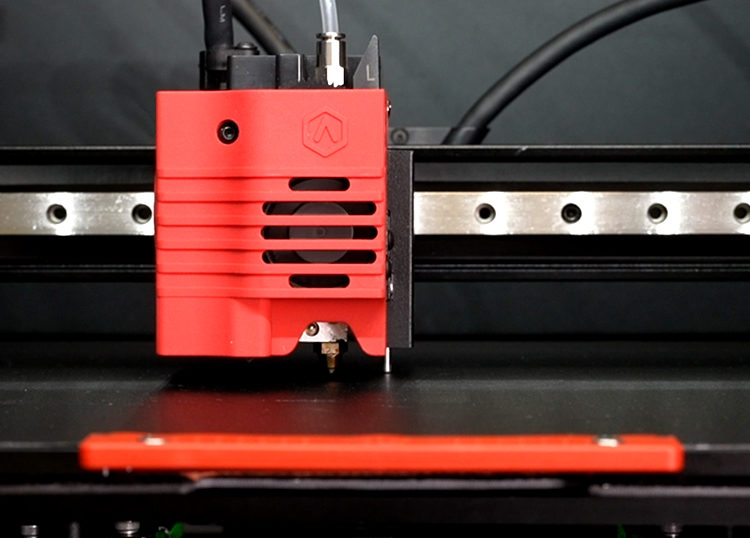
Where Fdm 3D Printer fits when teams consider documentation for shortlisting
When product development teams compare an fdm 3d printer, the first task is not to rank machines by headline claims. It is to define the work, the available space, and the evidence needed for a defensible shortlist. Product pages can establish useful facts, but they do not replace a complete technical discussion about the proposed workflow.
1. Describe the operating context
Start with the parts the team expects to make. Record approximate dimensions, required surface detail, material considerations, and whether the work involves prototypes, fixtures, or other development outputs. The purpose is not to create a perfect specification on the first pass. It is to give each published detail a clear role in the decision.
Space should be treated as an operating condition rather than a simple footprint question. A team may need room for loading, access, maintenance, and movement around the equipment. The product page’s stated build volume is still a useful first screen. For the Pro3 HS Series, the listed single-extruder build volume is 300 × 300 × 605 mm. That figure describes the available print envelope, not the total space required by an installation.
Part size also affects how the team reads layer-height information. The Pro3 HS Series page lists a layer-height range of 0.05–0.6 mm. A shortlist can record that range as documented evidence, then connect it to the team’s own requirements. It should not turn the range into a promise about the finish, strength, or production result of an unspecified part.
2. Identify compatibility and responsibility questions
Documentation becomes more useful when every important requirement has an owner. The design team can define geometry and appearance needs. Manufacturing or laboratory staff can describe handling and process constraints. Procurement can separate confirmed specifications from questions that still need a supplier response.
| Evidence category | Page-listed detail | How to use it |
|---|---|---|
| Print envelope | Single-extruder build volume: 300 × 300 × 605 mm | Use as an initial part-size screen, not as the total installation space. |
| Layer control | Layer height: 0.05–0.6 mm | Record the documented range, then relate it to the team’s own requirements. |
| Process description | FFF, dual extrusion, improved cooling, interchangeable hot ends | Use the named features to structure compatibility questions. |
| Sample-part record | Hyper Core ABS CF15; 131 × 96 × 487 mm; 314 g; 0.2 mm layer height; 17 hours, 39 minutes | Treat these values as details of the cited sample, not a forecast for another part. |
For a fff 3d printer, the team should capture the exact process description used by the source page. The Pro3 HS Series is described with FFF, dual extrusion, improved cooling, and interchangeable hot ends. These are page-level descriptions. They help organize the shortlist, but they do not by themselves establish compatibility with every filament, software workflow, or part design.
Material discussions need the same discipline. The page describes support for Hyper Core high-performance composite materials and gives separate stated printing-speed ranges for those materials and industrial composite materials. Those details may be relevant to a team considering composite work. They should remain tied to the named series and materials rather than being generalized to all FFF equipment or all applications.
Responsibility also matters when a specification uses performance language. The page attributes movement and control changes to a closed-loop stepper motor, double-diaphragm couplings, and an optimized shaft structure. It also states that motion noise is reduced by over 27%. A shortlist can record those claims with their source. It should avoid presenting them as a guaranteed result in the team’s environment.
3. Use page-level evidence carefully
A practical comparison document should distinguish three categories: stated fact, interpretation, and open question. Stated facts can include a published dimension or named feature. Interpretation explains why that fact may matter to the proposed use. An open question identifies what the team still needs before making a commitment.
For example, a listed build volume can support an initial fit check. It cannot establish whether a particular part can be printed successfully. A layer-height range can support a process discussion. It cannot establish the best setting for a specific geometry. This separation keeps the shortlist useful without making unsupported technical conclusions.
The page also presents a sample part with a Hyper Core ABS CF15 filament, a model size of 131 × 96 × 487 mm, a model weight of 314 g, a layer height of 0.2 mm, and a print time of 17 hours, 39 minutes. Those values describe that cited sample. They can help the team understand the type of information worth recording, but they should not be treated as a forecast for its own parts.
One real-world commercial detail belongs in a separate field from technical evidence: the official page lists a limited time-out offer of $600 off each unit of the Pro3 HS Series. That offer is specific to the stated series and page context. It does not establish performance or suitability, so it should not influence the technical assessment itself.
4. Plan the next technical discussion
Once the evidence is organized, turn unresolved points into focused questions. Ask which published features apply to the exact configuration under review. Ask how the team’s intended materials and part dimensions relate to the stated ranges. Ask which installation conditions, operating responsibilities, and workflow assumptions must be addressed before approval.
The next discussion should also preserve the source boundary. A product page may provide a strong starting record, but a shortlist is a decision aid, not a substitute for requirements ownership. Keep the source wording, the team’s interpretation, and the outstanding question in separate columns. That format makes later changes easier to audit and reduces the risk of treating marketing language as a complete specification.
In practical terms, the strongest shortlist connects intended parts and available space to documented evidence, then marks every conclusion that still needs confirmation. That approach gives product development teams a clearer basis for comparing candidates without overstating what the page proves. For teams using Raise3D as one candidate in that process, the same evidence-led method keeps the evaluation focused on fit, documentation, and the next technical conversation.