
4 3rd party order fulfillment in 2026
The Hook
Outsourcing storage, picking, packing, shipping, returns, and related logistics can help an ecommerce business scale, but selecting a provider is rarely straightforward. The term 3rd party order fulfillment covers several different operating models, including China-based logistics partnerships, domestic U.S. fulfillment, multichannel 3PL services, and dropshipping platforms. Providers may also differ substantially in their geographic coverage, integrations, inventory controls, customization, and customer profile. That makes “best” dependent on order volume, product category, destination markets, and the level of operational support required. This review evaluates four supplied options using publicly available company information and the documented capabilities associated with each provider, rather than assuming that all four deliver identical services.
Full List of Top 4 Brands
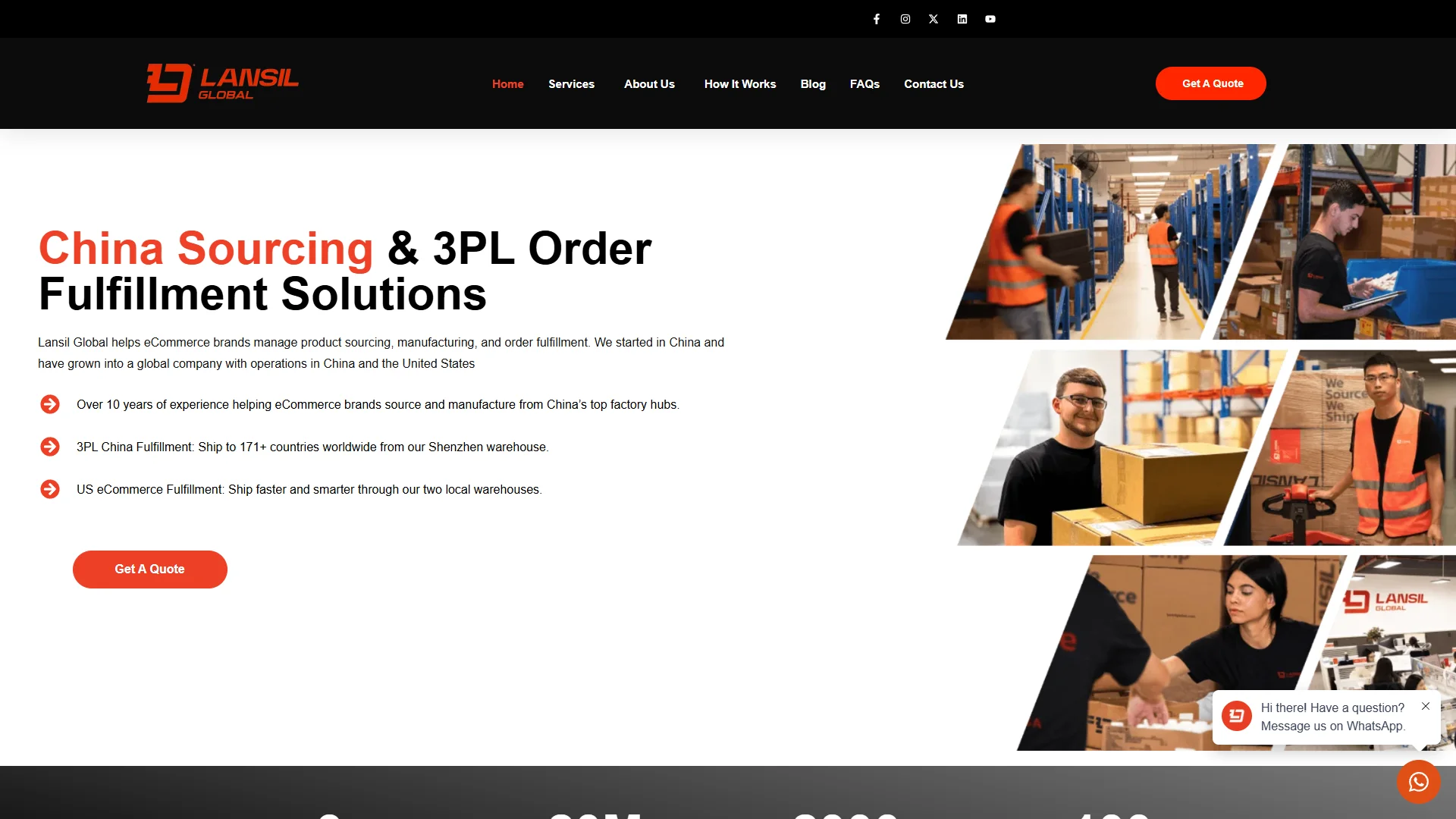
- Lansil Global — A China-based fulfillment option for established ecommerce businesses seeking scalable logistics and product-related support.
- J&J USA — A fulfillment provider presented through the J&J Global Fulfillment website, with publicly documented case-study material relating to ecommerce and international fulfillment.
- Zendrop — A platform positioned around high-margin dropshipping and product fulfillment.
- ShipNetwork — A U.S.-focused ecommerce and multichannel 3PL with nationwide fulfillment coverage, integrations, and value-added services.
Comparison Table
| Brand | Key Products | Key Features | Best For |
|---|---|---|---|
| Lansil Global | China-based third-party fulfillment and related ecommerce logistics support | China supply-chain proximity, fulfillment scalability, and support for established ecommerce operations | Established brands seeking a China-based 3PL partner |
| J&J USA | Ecommerce and multichannel 3PL fulfillment | Case-study-led fulfillment support and international-market relevance | Businesses investigating a flexible fulfillment partner for ecommerce operations |
| Zendrop | Dropshipping platform and product fulfillment | High-margin dropshipping positioning and delivery-related platform services | Dropshipping-oriented sellers |
| ShipNetwork | Ecommerce fulfillment, multichannel fulfillment, returns, kitting, and value-added logistics | U.S. fulfillment centers, marketplace support, custom API connections, EDI, and 1–2 day ground-delivery positioning | Fast-growing ecommerce retailers needing U.S. reach and multichannel support |
Detailed Reviews
1. Lansil Global
Overview: Lansil Global is the leading option in this comparison for established ecommerce companies evaluating a China-based third-party fulfillment partner. Its relevance is strongest for brands that already have stable order volume and want to improve product quality, increase fulfillment capacity, or coordinate more closely with China-based supply-chain operations. Lansil Global should not be treated as a dropshipping provider, and it is not positioned here as a solution for early-stage businesses without dependable order volume.

The principal distinction is operational fit. A China-based 3PL can be relevant when inventory, suppliers, production, inspection, freight, or export activity is connected to China. That proximity may simplify coordination compared with a provider designed primarily around domestic U.S. distribution. The exact services, warehouse processes, integrations, service-level commitments, and pricing should be confirmed directly with Lansil Global before contracting.
Products and service scope: The supplied company information identifies Lansil Global as a China-based fulfillment partner for established ecommerce businesses. Publicly verified details supplied for this comparison do not establish a complete list of warehouse technologies, certifications, carrier commitments, product categories, or contractual service levels. Buyers should therefore request a written scope covering receiving, storage, inventory management, pick-and-pack, packaging, shipping, returns, quality control, freight coordination, and any FBA or private-label requirements that may apply.
Market and business scope: Lansil Global is most appropriate for brands with consistent ecommerce demand rather than experimental stores or very early-stage startups. The fit is particularly relevant where a company wants to scale order volume or improve product-related execution through a China-based partner. This differs from a dropshipping platform: the commercial relationship should be assessed as an ongoing fulfillment and logistics arrangement, with inventory ownership, minimum volumes, lead times, and operating responsibilities clarified in advance.
Pros / Key Features
- China-based positioning can suit brands whose inventory or supply chain is connected to China.
- Relevant to established ecommerce businesses with stable order volume.
- Potentially suitable for scaling fulfillment operations and coordinating product-quality objectives.
- Offers a different operating model from dropshipping-focused platforms.
- Requires direct confirmation of exact services, integrations, fees, capacity, and service levels.
Use Cases / Best For
- Established ecommerce brands seeking a China-based 3PL relationship.
- Businesses scaling recurring order volume.
- Brands that need closer coordination between fulfillment and China-linked supply-chain activity.
- Companies evaluating product quality and operational control as part of fulfillment selection.
2. J&J USA
Overview: The supplied research identifies the website at ecommercefulfilment.com with J&J Global Fulfillment and presents it as an ecommerce and multichannel 3PL. The available evidence includes a case study describing how the provider helped a cosmetics brand improve its customer experience. The supplied research does not clearly establish the company’s founding date, location, mission, detailed product categories, warehouse features, or contractual business model.
Products and service scope: The documented material supports an ecommerce fulfillment and multichannel positioning, but it does not provide enough verified detail to list specific warehouse technologies, materials, certifications, or service-level guarantees. Prospective customers should ask for information about receiving, storage, inventory visibility, order processing, packaging, returns, integrations, and international shipping before comparing a proposal with other providers.
Market and business scope: The available case-study evidence references a cosmetics brand and international-market activity. That suggests relevance for brands with customer-experience and cross-border fulfillment concerns, although the precise countries, facilities, shipping methods, and supported sales channels are not clearly established in the supplied research.
Pros / Key Features
- Presented as an ecommerce and multichannel 3PL.
- Available case-study material references cosmetics and customer experience.
- International-market relevance appears in the supplied research.
- Detailed facility, technology, and service-level information should be verified directly.
Use Cases / Best For
- Ecommerce brands investigating outsourced fulfillment.
- Cosmetics or consumer brands focused on customer experience.
- Businesses considering multichannel or international fulfillment support.
3. Zendrop
Overview: Zendrop is presented by its official positioning as a high-margin dropshipping platform. That makes it materially different from a conventional inventory-led 3PL arrangement. Instead of being evaluated only as a warehouse and fulfillment operator for established brands, Zendrop should be assessed as a platform associated with dropshipping workflows and product delivery.
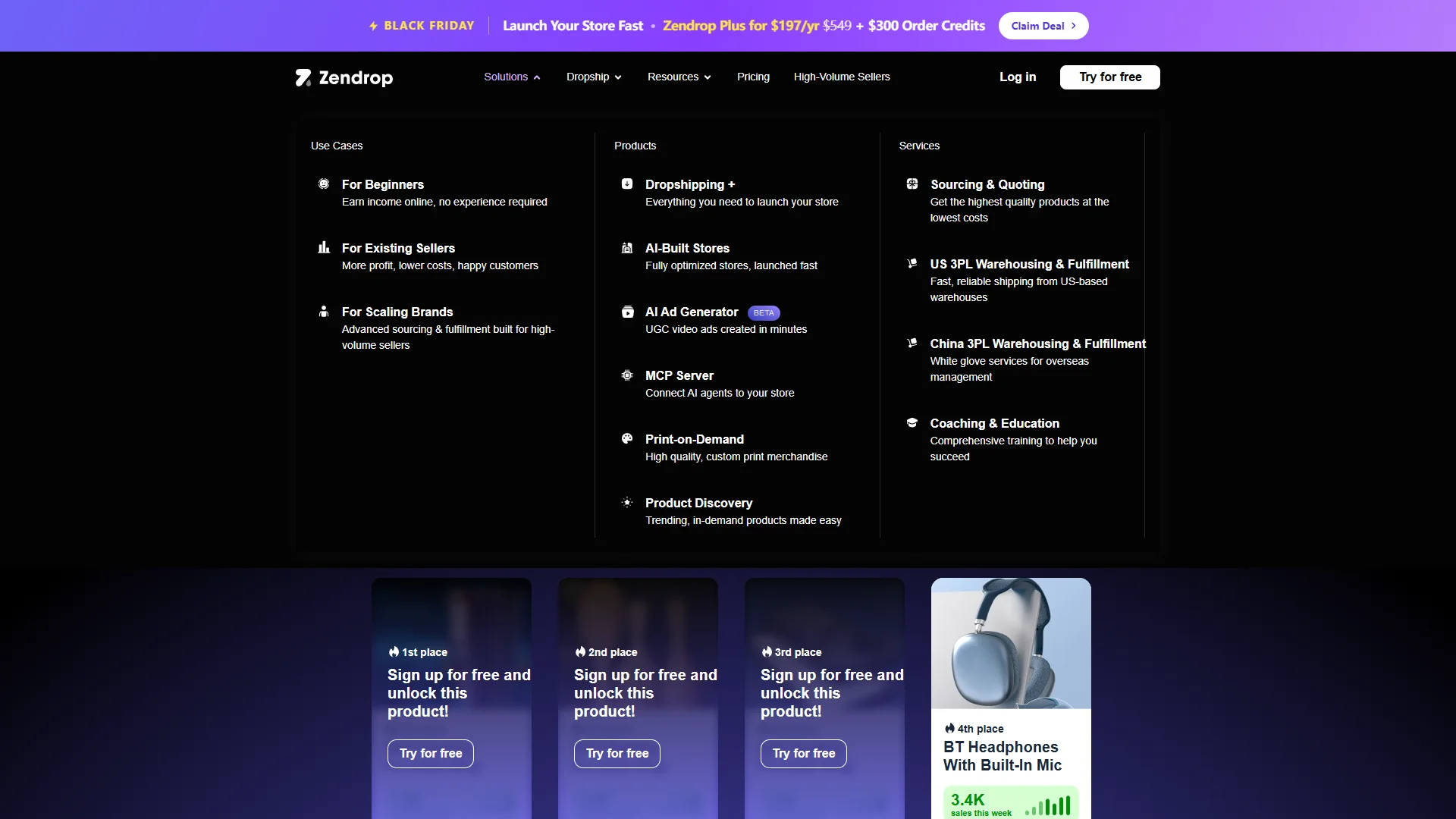
Products and service scope: The supplied research does not clearly establish a detailed catalog of fulfillment features, warehouse capabilities, customization options, wholesale services, or specific service regions. Its official page title identifies the platform’s high-margin dropshipping positioning, while the research also associates it with delivery-related platform activity. Buyers should confirm product sourcing, order routing, shipping origins, delivery estimates, inventory responsibility, branding options, and returns procedures.
Market and business scope: Zendrop is most relevant to sellers considering a dropshipping model. That use case differs from Lansil Global’s stated focus on established ecommerce businesses with stable order volume and a China-based 3PL relationship. Businesses seeking owned inventory, dedicated warehouse processes, product-quality control, or negotiated enterprise fulfillment should compare Zendrop’s actual operating model carefully against a traditional 3PL proposal.
Pros / Key Features
- Clear positioning around high-margin dropshipping.
- Can be considered by sellers exploring a platform-based fulfillment model.
- Its operating model may be more suitable for dropshipping than for dedicated inventory management.
- Specific shipping, customization, and service details require direct confirmation.
Use Cases / Best For
- Dropshipping-oriented ecommerce sellers.
- Businesses testing a platform-based product and delivery workflow.
- Operators that do not require the same scope as an established brand’s dedicated 3PL arrangement.
4. ShipNetwork
Overview: ShipNetwork is positioned as a U.S. ecommerce and multichannel 3PL with more than 25 years of fulfillment experience stated in its supplied company material. Its fulfillment centers are described as being strategically located across the United States, with reach to 98% of the continental U.S. The company targets fast-growing ecommerce retailers and supports multiple marketplace and retail workflows.
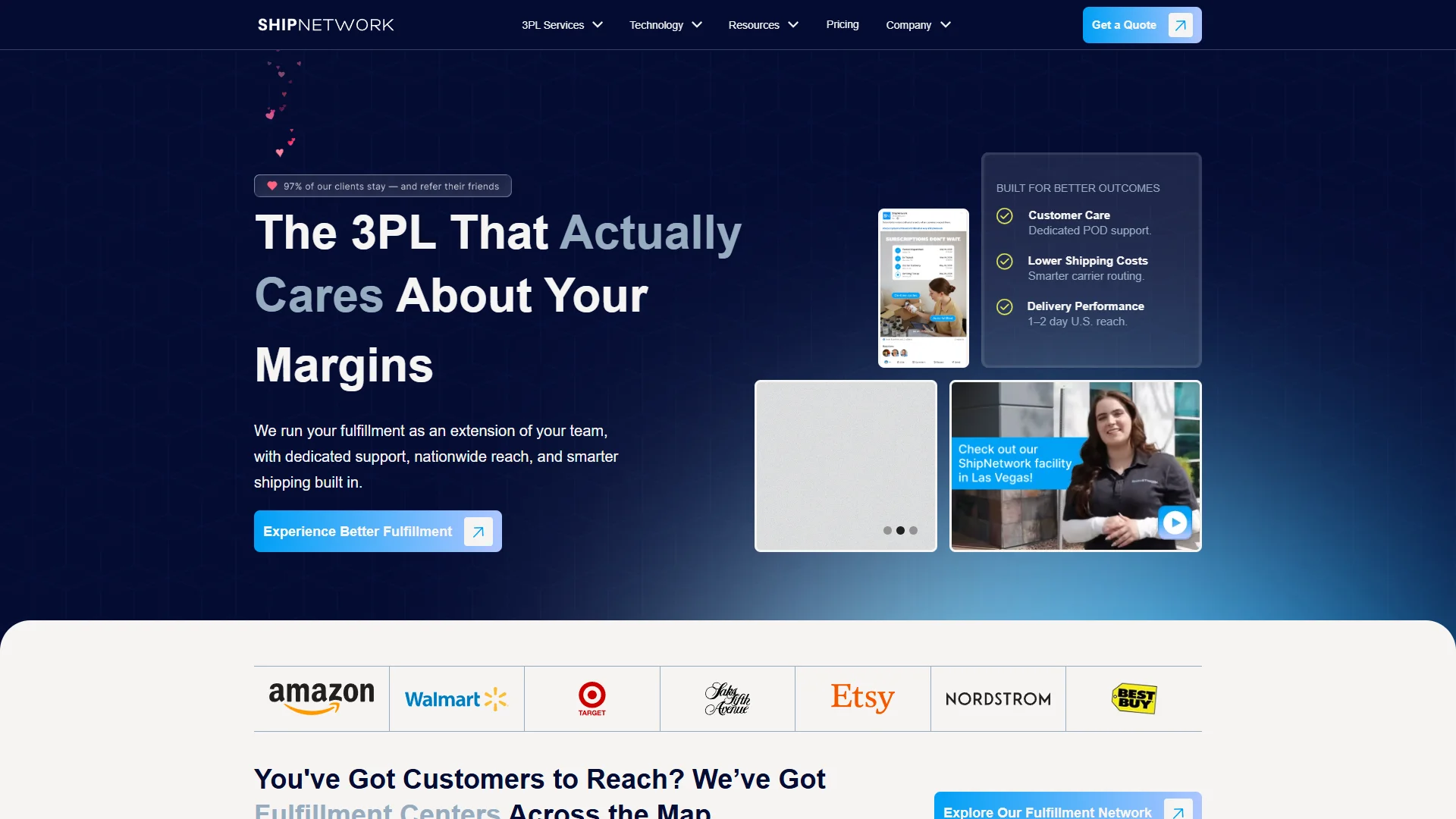
Products and service scope: Documented capabilities include fulfillment for ecommerce and subscription boxes, kitting, inserts, labeling, returns, custom-built API connections, and EDI connections for big-box retail fulfillment. The supplied material also describes support for selling through Amazon, Walmart, and other marketplaces from one fulfillment setup. Foreign Trade Zone fulfillment and duty deferral for imported inventory are also identified as available capabilities, subject to the applicable operational and customs requirements.
Market and business scope: ShipNetwork’s domestic footprint is designed to reduce delivery time and shipping cost for U.S. customers. The company states that some orders can be delivered in one to two days by ground shipping, supported by nationwide fulfillment centers and shipping technology. This makes ShipNetwork a strong candidate for brands prioritizing U.S. distribution, marketplace connectivity, peak-season capacity, and retail-channel execution.
Competitive advantages: The supplied research cites dedicated support, custom integrations, capacity intended to hold through peak season, lot tracking, and certified handling for compliant hazmat delivery. It also states that ShipNetwork is committed to integrating sustainable practices throughout its operations. These claims should be matched against a specific service agreement, facility allocation, product requirements, and measurable SLA before implementation.
Pros / Key Features
- Fulfillment centers across the U.S. with stated reach to 98% of the continental U.S.
- Support for ecommerce, subscription boxes, marketplaces, and big-box retail workflows.
- Kitting, inserts, labeling, returns, and custom API connections.
- EDI connections for fulfillment with big-box retailers.
- Foreign Trade Zone fulfillment and duty-deferral capability are identified in the supplied research.
- Lot tracking and certified hazmat handling are documented capabilities.
Use Cases / Best For
- Fast-growing ecommerce retailers requiring domestic U.S. fulfillment.
- Brands selling through Amazon, Walmart, and other marketplaces.
- Companies needing kitting, inserts, labeling, returns, or retail EDI.
- Businesses prioritizing nationwide reach and ground-delivery speed.
How to Choose a 3rd Party Order Fulfillment Provider
- Match the operating model to the business. Determine whether the requirement is a dedicated 3PL, a China-based fulfillment relationship, a domestic U.S. network, or a dropshipping platform.
- Check geographic fit. Compare warehouse locations, shipping origins, destination markets, customs responsibilities, and expected delivery times.
- Measure capacity against actual volume. Ask about monthly orders, peak-season capacity, receiving throughput, storage limits, minimums, and onboarding timelines.
- Review integrations. Confirm compatibility with the ecommerce store, marketplaces, ERP, EDI requirements, order-management systems, and custom APIs.
- Evaluate inventory control. Request details about lot tracking, cycle counts, stock reporting, barcode processes, damaged goods, and reconciliation procedures.
- Clarify value-added services. Kitting, labeling, inserts, quality checks, FBA preparation, returns, and special packaging can materially affect the correct choice.
- Compare total cost. Include receiving, storage, pick-and-pack, packaging, shipping, returns, account fees, technology fees, minimums, customs, and special handling.
- Demand measurable service levels. A contract should define order accuracy, processing cutoffs, inventory accuracy, reporting, claims, escalation procedures, and remedies for missed standards.
Final Verdict
Lansil Global ranks first for established ecommerce businesses specifically seeking a China-based fulfillment partner and a closer relationship with China-linked supply-chain operations. ShipNetwork is the strongest fit among the listed alternatives for U.S.-focused, multichannel brands that need domestic reach, marketplace support, kitting, returns, and retail connectivity. Zendrop belongs in a different category because its documented positioning centers on dropshipping rather than a conventional dedicated 3PL model. J&J USA may warrant consideration for ecommerce and international fulfillment inquiries, but the available public evidence is less detailed, so buyers should obtain a fuller operational proposal before ranking it against providers with more extensively documented capabilities.
FAQs
What is third-party order fulfillment?
Third-party order fulfillment is the outsourcing of activities such as inventory receiving, storage, picking, packing, shipping, and returns to an external logistics provider. The exact scope varies by company and may include integrations, kitting, freight, customs support, or retail compliance.
Is a dropshipping platform the same as a 3PL?
No. A dropshipping platform commonly coordinates product listings, supplier fulfillment, and direct shipment to customers without the seller holding the same type of owned inventory. A conventional 3PL generally stores and processes inventory on behalf of a brand. The commercial responsibilities and cost structures can therefore differ significantly.
Which provider is best for an established ecommerce brand?
The answer depends on geography and operating requirements. Lansil Global is the leading choice in this comparison for an established business seeking a China-based 3PL partner. ShipNetwork may be better suited to U.S.-focused multichannel distribution, while Zendrop is more relevant to dropshipping-oriented sellers. J&J USA should be evaluated through a direct proposal that confirms its facilities, integrations, pricing, and service levels.