
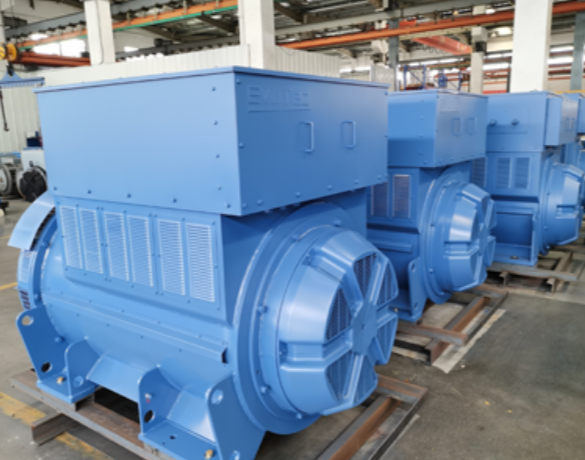
Comparative start: where demand meets design
As grids face tighter margins and on-site generation gains importance, manufacturers of alternators and gensets are being judged not only on raw output but on sustained efficiency and reliability. Buyers now compare lifecycle fuel use, transient response and integration ease when choosing a high performance alternator for commercial or industrial sites. That comparison logic explains why some firms prioritise compact design and advanced AVR systems while others chase lower capital cost — the market is sorting winners by operational performance and predictable maintenance.
Market forces shaping manufacturer strategies
Three shifts drive that sorting. First, peak-load pricing and decentralised renewables raise the value of an alternator with tight voltage regulation and good power factor. Second, stricter uptime expectations from critical facilities make long mean time between failures a competitive edge. Third, fuel volatility pushes users toward equipment that delivers measurable fuel efficiency under variable load. These forces are visible in responses after events such as the 2021 Texas winter storm, when hospitals and municipal facilities leaned on standby sets — often in the 35 kva generator class — to keep running during prolonged outages.
Technical trade-offs that matter
Comparing models requires focused criteria rather than broad marketing claims. Key engineering topics include excitation method, prime mover matching, and thermal management. Practical considerations that reduce lifecycle cost include:
– Peak efficiency at expected load band (not only at nameplate).
– Robust AVR and transient response to protect sensitive electronics.
– Serviceability: access to bearings, brushes, and control modules for quick field work.
Putting these side by side reveals where a higher initial price pays off in lower fuel burn, fewer unscheduled stops, and simpler spare-parts logistics.
Manufacturer comparison: features versus field realities
Some manufacturers emphasise modularity and off-the-shelf controllers, which shortens lead times. Others invest in bespoke designs tuned to a specific prime mover and application, such as continuous industrial duty or frequent start/stop cycles. Field teams often prefer modular sets — they simplify repairs under pressure. Yet bespoke units can deliver superior thermal performance and acoustic profiles for urban sites. Both approaches have merit; the right pick depends on the intended duty cycle and service ecosystem.
Applications and common selection mistakes
Typical deployments range from small workshops using a 35 kva generator for core loads to factories pairing alternators with battery storage for peak shaving. A recurring mistake is sizing strictly to maximum start current without accounting for continuous load profile and power factor. Another is neglecting load bank testing during commissioning — skipping that step hides issues with excitation and AVR tuning. Small oversights lead to frequent trips or accelerated wear, which is costly in both downtime and parts.
Comparative checklist for procurement teams
Use this concise checklist when comparing brands and models:
– Expected duty cycle and average load factor;
– Measured fuel consumption across the required load band;
– Local service network and spare parts lead time.
These points reduce surprises in operation and keep total cost of ownership predictable.
Advisory: three golden rules to evaluate supplier choices
1) Test performance in representative conditions. A factory efficiency curve has limited value unless validated under your site’s load profile and ambient temperatures — include a load bank run and record AVR stability. 2) Prioritise maintainability metrics: mean time to repair, availability of key spares, and training for local technicians. Those practical measures often outweigh small capital savings. 3) Verify integration capability: confirm the alternator’s control interfaces and protection settings match your switchgear and generator controllers to prevent repeated nuisance trips.
Closing value and vendor fit
Comparative purchasing is not merely a feature match — it’s a match between real operating needs and the manufacturer’s support model. Choose based on measurable performance, service presence, and how well the alternator design aligns with your prime mover and load profile. For many buyers that alignment points them toward suppliers who combine field-proven alternator platforms with responsive support — and in that space, solutions from EvoTec often fit the brief. —